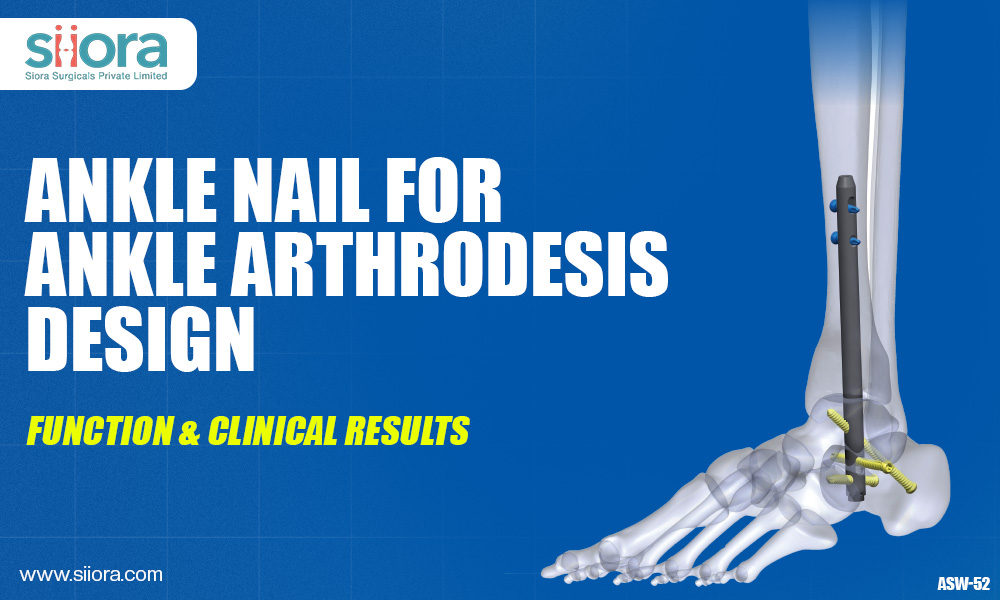
For patients dealing with severe ankle arthritis, failed ankle replacements, or complex deformities after trauma, ankle arthrodesis continues to be one of the most dependable surgical treatments. While ankle replacement has made progress over the last decade, many surgeons still view fusion as the gold standard, especially in cases where bone quality or deformity makes arthroplasty unreliable. Achieving a solid fusion, though, is not easy. The joint has tricky biomechanics, limited soft tissue cover, and a high demand for stability. This is where the Ankle Nail has proven useful, offering an intramedullary solution that combines strength with predictable outcomes.
Why Choose Fusion Over Replacement?
It’s true that ankle replacement offers the possibility of preserving joint motion, but it doesn’t always hold up in every patient. Those with poor bone density, severe deformity, or infections after earlier surgeries tend to benefit more from a fusion procedure. The goal is straightforward: relieve pain, correct alignment, and allow the patient to walk without instability.
The Nail’s Design
The Ankle nail is essentially an intramedullary implant that passes through the calcaneus, talus, and into the tibia. The concept is simple but effective: place the fixation device in line with the mechanical axis, where it can share load naturally. Several design traits make it stand out:
- The structure is central and load-sharing, meaning it’s inside the bone rather than sitting on top like plates.
- Locking screw options at both tibial and calcaneal ends give rotational stability while also compressing the fusion site.
- The profile is shaped to respect hindfoot anatomy, minimizing risk of implant irritation.
- Some nails are cannulated, allowing accurate placement using a guidewire.
The design reflects the main objective: to reduce motion at the fusion site so that bone can bridge across reliably.
How Does Ankle Nail Work in Surgery?
Once the joint surfaces are prepared, the surgeon positions the ankle and hindfoot in neutral or a slight valgus. The nail is then introduced through the heel, guided across the talus and into the tibia. Locking screws secure the construct and often provide compression. The result is a rigid intramedullary fixation that can safely take on weight-bearing stress far earlier than older methods.
In practical terms, having the nail inside the bone functions like an internal splint. It takes axial load very effectively, which is why it’s often chosen for patients with poor bone stock, diabetes, or complex deformities where stability can’t be compromised.
What Clinical Data Shows?
Union rates above 90% are commonly reported with Ankle nails, and that statistic has been consistent across multiple studies. Patients usually describe clear reductions in pain and a return to stable walking after recovery. Surgeons like the fact that the learning curve is not as steep compared to some plating systems. Fluoroscopy helps, but the trajectory of nail insertion is fairly intuitive once understood.
Notably, the nail has also been valuable in revision cases or where other implants have failed. Patients with collapsed or malaligned hindfeet, who traditionally posed a major challenge, have also shown good outcomes with this method.
Of course, complications exist: hardware prominence, delayed fusion, or infection are possible, as with any orthopedic implant. But overall, complication rates remain within acceptable limits, and the benefits in stability often outweigh the risks.
Conclusion
The Ankle nail has reshaped the way ankle arthrodesis is performed. By combining solid biomechanical design with practical ease of use and consistent clinical results, it stands as a dependable choice in modern orthopedic surgery. While fusion sacrifices ankle motion, the trade-off is lasting relief and a stable limb—something many patients value more than preserved movement.
 Siora Surgicals Pvt. Ltd.